
Workspace settings
Settings (at the bottom of the navigation) holds what the whole workspace shares. Each reconciliation’s own settings are in its designer. You see the sections your role allows; most changes need an admin.
Some things that used to be here have their own pages: Lookup tables are under Data in the navigation (Lookup tables), alert rules and Slack and Teams are on the Notifications page, and members and roles are under Members.
| Section | What is there | Explained in |
|---|---|---|
| Organization | Name, code, members, currency, number and date formats, time zone | Below |
| Appearance | Colours and light or dark theme | Below |
| Library | Reconciliation types, templates, the field library | Below |
| Workflow defaults | Break states, labels, default approval, deadlines and workflow rules | Below |
| Journal rules | Rules that raise journals from records | Journals |
| Change control | Whether changes to live reconciliations need approval | Versions and approval |
| Rule language | The guide, every function, your own functions, and a place to try rules | Writing rules |
| API access | API keys | The API |
| Exchange rates | The rates currency conversion uses, entered one at a time or pasted from a spreadsheet | Currency conversion |
| Sign-in security | Who must use two-step sign-in, and who has it set up | Below |
| Single sign-on | Sign in with your own identity provider (Professional and Enterprise) | Single sign-on |
| AI | Whether AI is on, and what it may see | Below |
Organization
Section titled “Organization”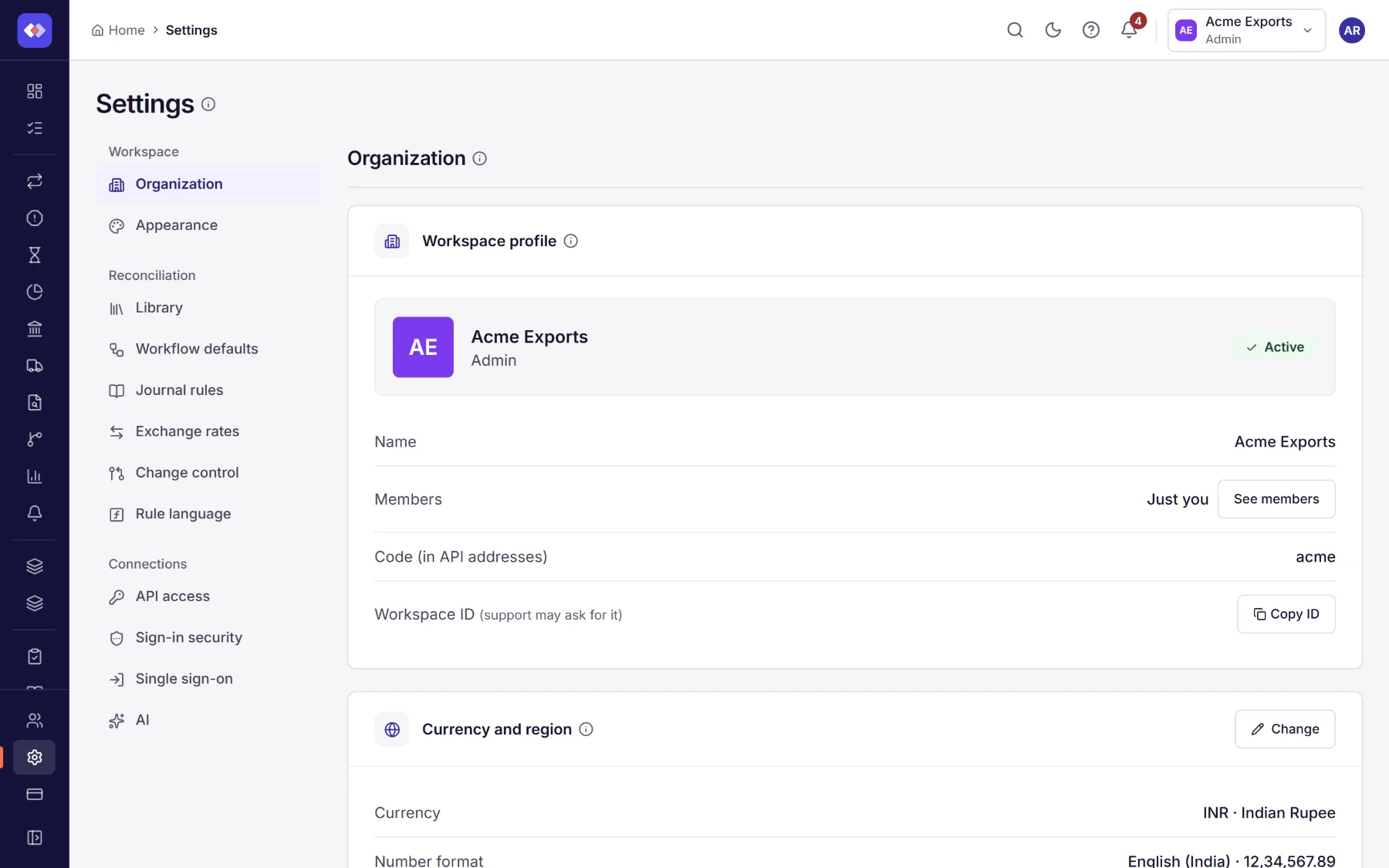
- Workspace profile: the workspace ID and code (fixed), its name, who is in it (Just you, or how many members, with the seats its plan holds) and its industry. The owner can Rename the workspace once; no two workspaces can have the same name.
- Currency and region: the workspace’s currency, the number format (which decides how numbers are
written, such as
1,25,000.50or125,000.50), the date format and the time zone, for everyone in the workspace. Owners and admins change them with Change. A new workspace starts with the currency and formats of the region its creator’s browser is set to, or US dollars when that is not known. - Open when I sign in: the workspace you land in after signing in, when you belong to more than one. See Your default workspace.
- Workspace data (the workspace’s owner only): export it, or delete it. Both below.
Exporting a workspace
Section titled “Exporting a workspace”Export workspace data downloads a zip of every record in the workspace: reconciliations and their versions, data
source settings, runs and their counts, breaks with their comments and decisions, open items, journals, lookup tables,
members, roles, settings, the audit trail. Each part of RefinePoint is a file of JSON lines (one record a line, with
the table it is from), and manifest.json says what is in it: how many records of each kind, when and by whom it was
made.
An export does not include files (data source files, statements read from PDFs and pictures, invoices, attachments) or results record by record; download those where they are. It never includes secrets: passwords, keys, tokens, webhook links and connection credentials are left out.
Deleting a workspace
Section titled “Deleting a workspace”Delete workspace deletes the workspace and everything in it, for everyone, for good: type the workspace’s code to confirm. Every part of RefinePoint then removes its data. A licence it used is freed at once. If it was your only workspace, you get a new, empty one the next time you sign in.
- A workspace still paying for a plan cannot be deleted until the subscription is cancelled (Billing, Payment method).
- Export first if you may need anything: nothing can be brought back.
Without deleting, the results of old runs are kept only as long as the plan says (N-day data retention), then removed by the nightly data retention job; the latest run of each reconciliation is always kept.
Appearance
Section titled “Appearance”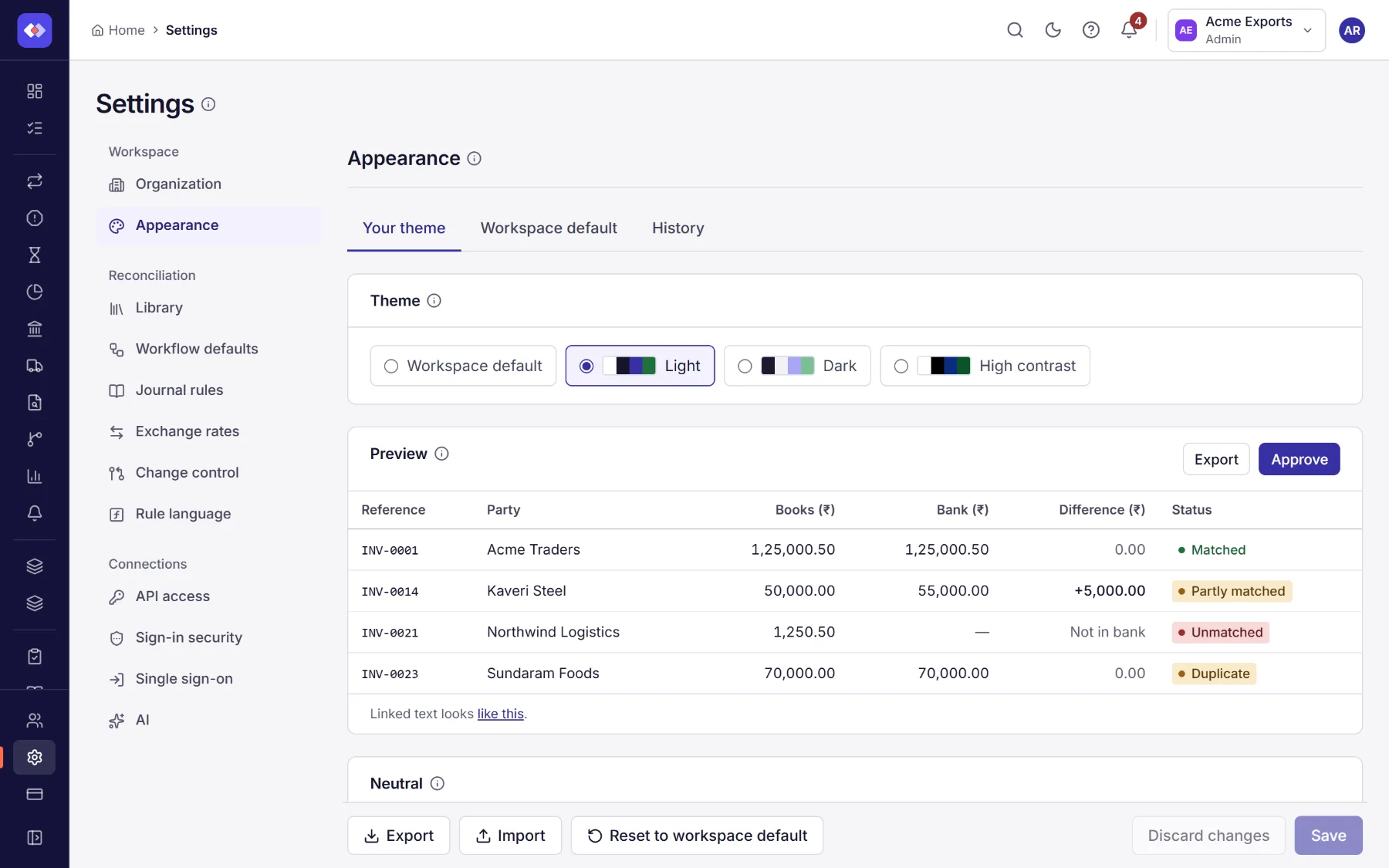
- Your theme: light, dark, high contrast, or the workspace default, just for you.
- Workspace default: what everyone sees unless they choose otherwise; admins can change its colours, for example to your brand, with a live preview. Export a theme to reuse it elsewhere, or import one.
- History: every change to the workspace default, newest first.
Library
Section titled “Library”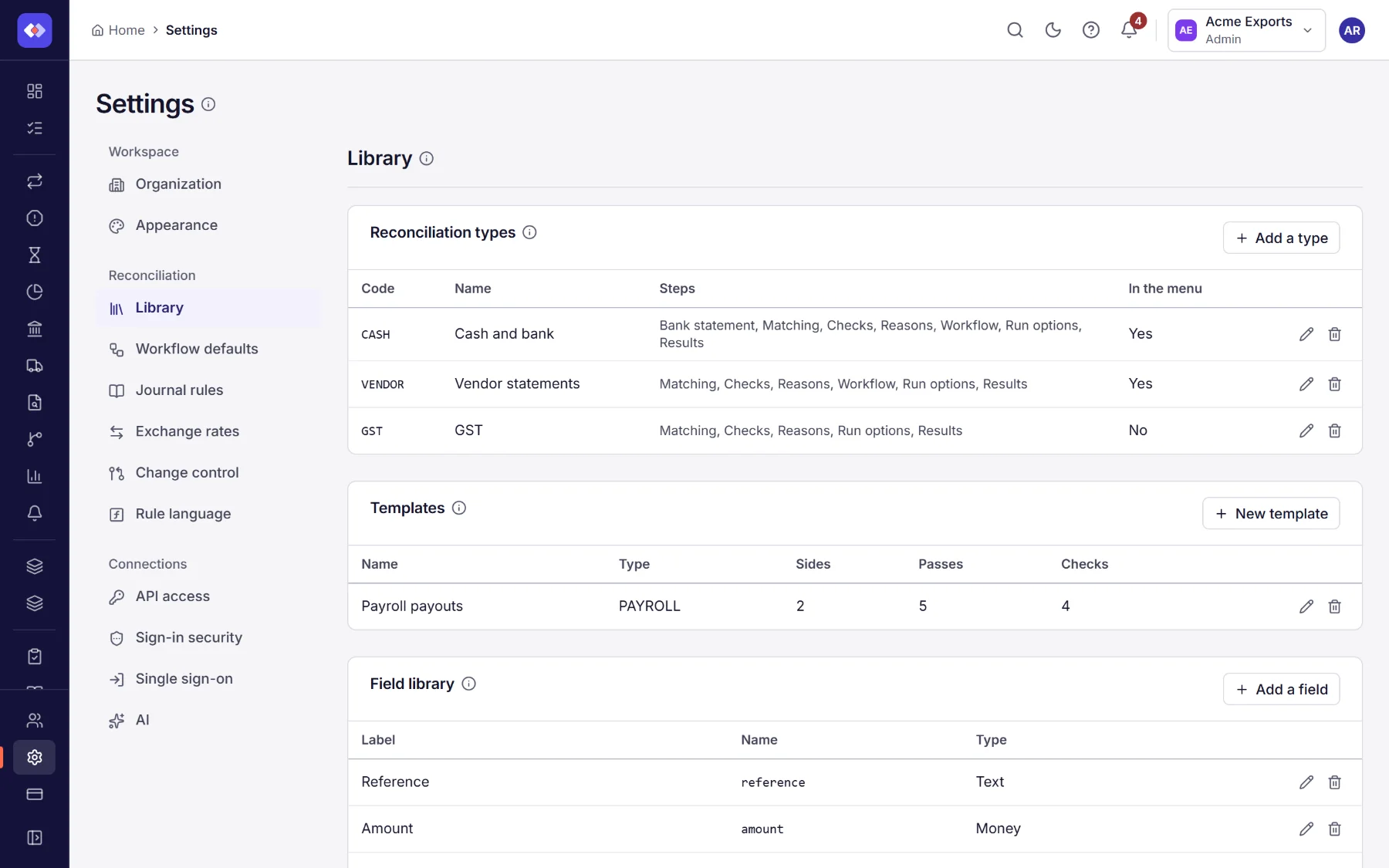
- Reconciliation types: the kinds of reconciliation in your workspace (Cash and bank, Vendor statements, GST…), each with a code, a name and a description. A type shown in the menu gets its own results page in the navigation.
- Templates: starting points for new reconciliations. Make one from scratch, from an example, or with Save as template in the designer. The examples that come with RefinePoint are available until you make your own. See the templates reference.
- Field library: fields with their type and role that the designer offers ready-made. See Fields.
Workflow defaults
Section titled “Workflow defaults”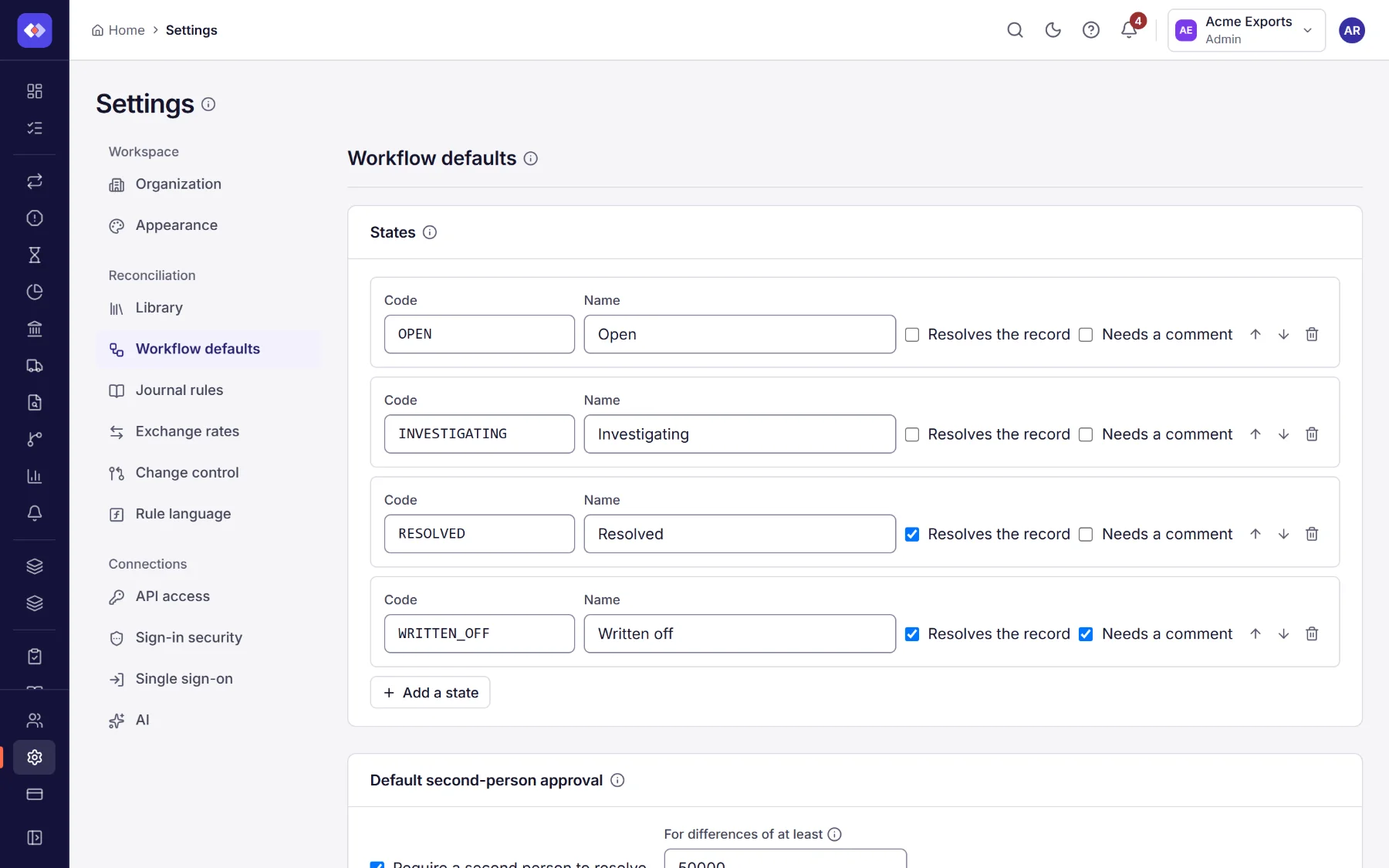
- States: the states every break moves through, in every reconciliation, such as Open, Investigating, Resolved, Written off. Each has a code and a name; the first open state is where new breaks start, and a resolving state settles the break. Choose whether a state needs a comment. Reorder with the arrows.
- Labels: the tags people put on breaks, such as Timing or Ask bank.
- Default second-person approval: a resolution proposed by one person waits until someone else approves it, optionally only for differences of at least an amount.
- Default deadlines: a due date a number of days after the run, and escalation every so many days.
- Default workflow rules: who gets new breaks, their due date and label, by rule.
Each reconciliation can set its own; see Workflow.
Sign-in security
Section titled “Sign-in security”Choose who must use two-step sign-in (a code from an authenticator app, or a security key or passkey, as well as a password): Not required, Owners and admins, or Everyone. The table shows each member and whether they have it set up.
Someone it applies to who has not set it up cannot open the workspace: they see a banner telling them to set it up on their profile, and the workspace opens as soon as they have. People who sign in through the workspace’s single sign-on are let through; your identity provider decides how they sign in. To require it, you must have it set up yourself, so the setting can never lock out the people who manage the workspace.
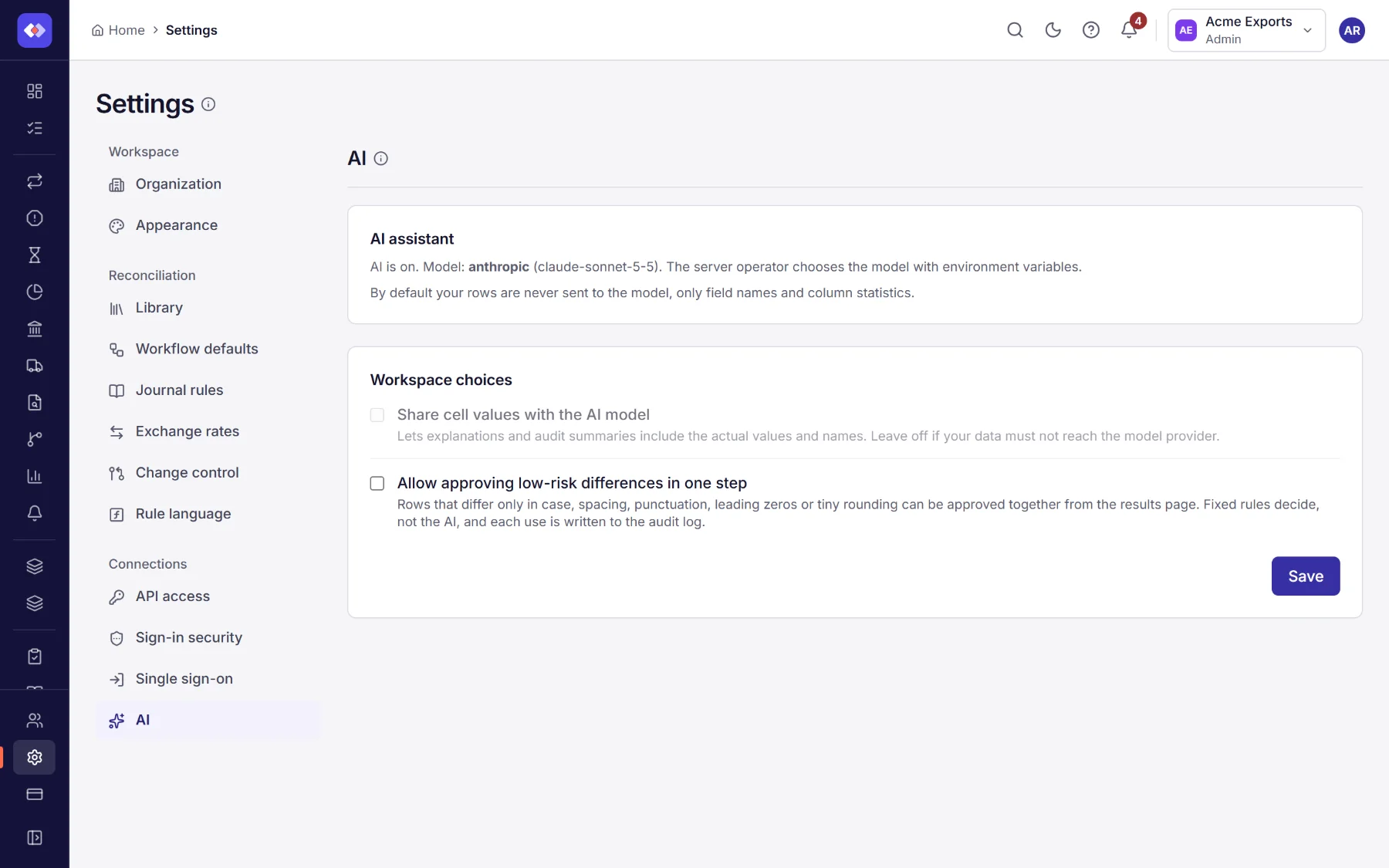
The top of the page says whether AI is on and which model is used. That is decided by whoever runs your RefinePoint server. When AI is off, features that work with fixed rules (mapping suggestions, triage, explanations) still work.
The workspace’s own choices, which only admins change:
| Choice | Effect |
|---|---|
| Share cell values with the AI model | Lets explanations and summaries include actual values and names. Leave it off if your data must not reach the model provider. The server can forbid it altogether. |
| Allow approving low-risk differences in one step | Rows that differ only in case, spacing, punctuation, leading zeros or tiny rounding can be approved together from the results. Fixed rules decide, not the AI, and each use is written to the audit log. |