
File routing
Most reconciliations get a new file every day or month: today’s bank statement, this month’s vendor statement. File routing receives those files, sends each one to the right side of the right reconciliation, and can run the reconciliation as soon as its files are in. It is in Data → File routing.
How files arrive
Section titled “How files arrive”| Channel | How it works |
|---|---|
| Upload | Send a file on the Received files tab, from your computer. |
| API | A system posts the file with an API key. |
| Every route has its own email address. Attachments mailed there go to that route, as if dropped in the SFTP inbox. See Statements by email. | |
| SFTP inbox | Your workspace’s own SFTP account. Banks and systems drop files there; each is routed once it has finished uploading, then removed from the inbox. |
| Watched folder | An SFTP or FTP folder on your own server, checked every few minutes through a saved connection. New files are routed, then moved to an archive folder if you set one. |
The map
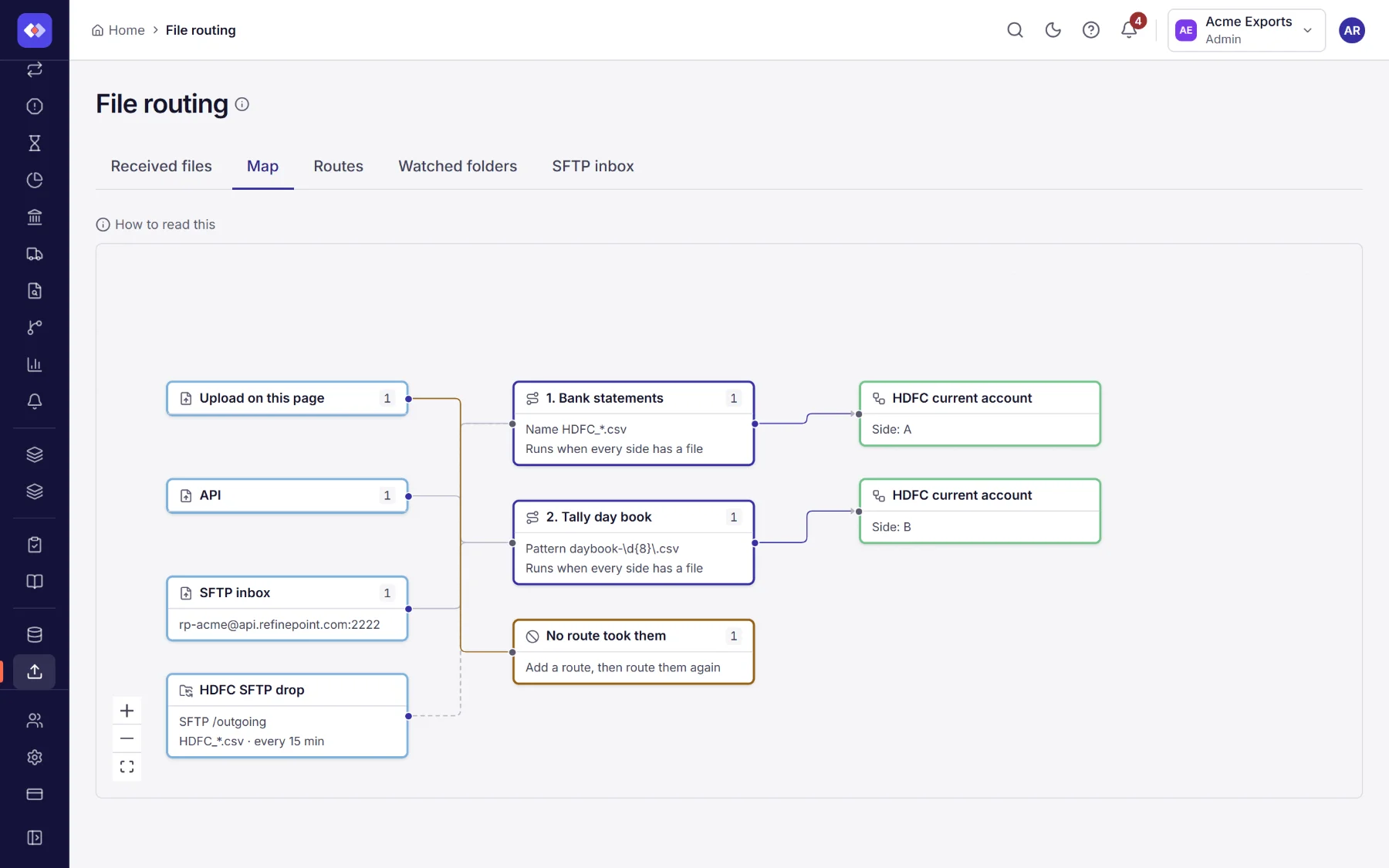
Section titled “The map”The Map tab draws it all: the channels on the left, the routes in the middle (tried in order), and the reconciliation sides they feed on the right. Numbers are files received recently. Select a route to change it.
Routes
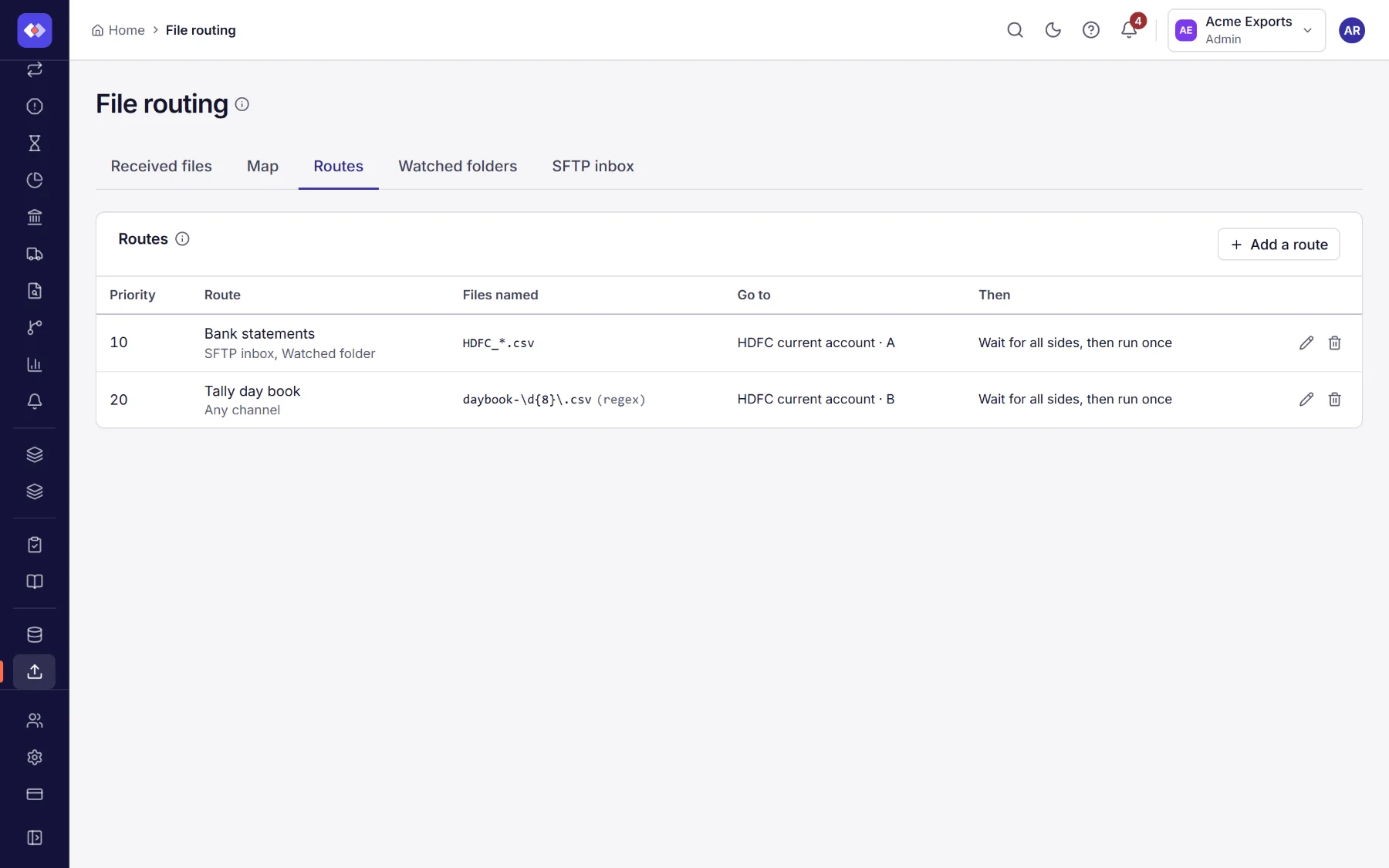
Section titled “Routes”A route says: files named like this, arriving by these channels, go to this side of this reconciliation, and then…
| Setting | Meaning |
|---|---|
| Name | Shown on the map and in the received files. |
| Priority | Routes are tried in order, lower numbers first. The first active route that fits decides where a file goes. |
| Files named | A pattern for the file name. Simple patterns use * (anything) and ? (one character), as in HDFC_*.csv. Regular expression is there for anything more involved. |
| Files that arrive by | Upload, API, SFTP inbox, watched folder, or any combination. |
| Process and side | Where the file goes: a side of a reconciliation. |
| Then | Wait for all sides, then run once (for a bank statement and a cash book that both arrive daily), Run for every file, or Only store the file and run by hand later. |
| Give up after (hours) | With Wait for all sides: how long the other files may take after the first one arrives. Leave it empty to wait for ever. |
Waiting for every side
Section titled “Waiting for every side”A reconciliation with several sides usually gets one file per side, often from different people at different times. With Wait for all sides, then run once, RefinePoint holds each file until every side that has a route has one, then starts a single run that uses them all. The Received files tab says what each waiting file is waiting for.
- If a newer file for the same side arrives first, it replaces the one that was waiting.
- With Give up after (hours) set, files that are still incomplete when the time is up become Timed out, no run starts, and the workspace gets an alert naming what is missing.
- It works the same for reconciliations built in the designer, with up to four sides, and for the two-sided wizard ones.
Received files
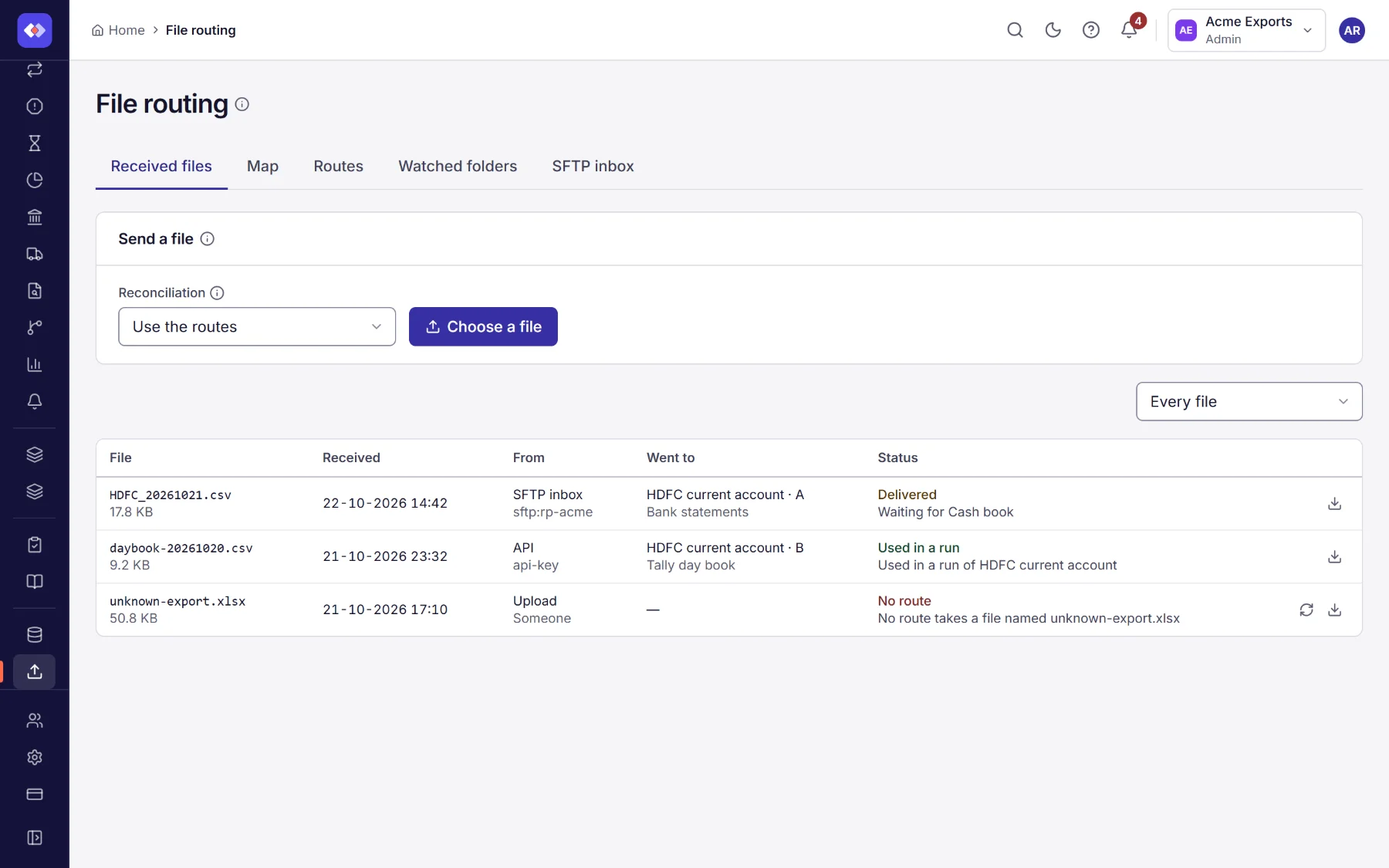
Section titled “Received files”Every file that arrived, how, when, where it went and its status:
| Status | Meaning |
|---|---|
| Delivered | It reached a reconciliation side and is waiting to be used. |
| Used in a run | A run used it. |
| No route | No route fitted its name and channel. Add or fix a route, then Route again. |
| Failed | It could not be read or delivered; the message says why. Fix it, then Route again. |
| Replaced by a newer file | Another file for the same side arrived before the run, so only the newer one is used. |
| Timed out | The other sides’ files did not arrive in time. No run started, and you got an alert. Send the missing file, then Route again. |
Download a file to see exactly what arrived. Files are kept for 90 days.
Send a file lets you upload one yourself: let the routes decide, or choose the process and side; a file you place yourself is only stored, and you run the reconciliation when ready.
Statements by email
Section titled “Statements by email”Every route has its own address, shown under its name on the Routes tab, for example
3f9a1c27b04e88d2@in.refinepoint.com. Choose the copy button and give the address to your bank or to whoever sends the
statements: many banks can email a daily statement to any address.
- Each attachment mailed there arrives on the Email channel and goes to that route: stored on its side, then run as the route says. The route’s file name pattern still applies; an attachment that does not fit it shows in Received files as No route, saying which names the route takes. Pictures that do not fit (logos in signatures) are left out without a trace.
- Only from: in the route’s settings, list the addresses or domains that may send to it, such as
statements@hdfcbank.com, @acme.com. Mail from anyone else is ignored. Leave it empty to take mail from anyone who knows the address. - New address: gives the route a new address. Mail sent to the old one is no longer received, so tell everyone who sends files there.
- Received files shows such files as By email, from the sender, with the message’s subject.
An address works whatever channels the route takes for other files. Each file can be up to 50 MB.
The SFTP inbox
Section titled “The SFTP inbox”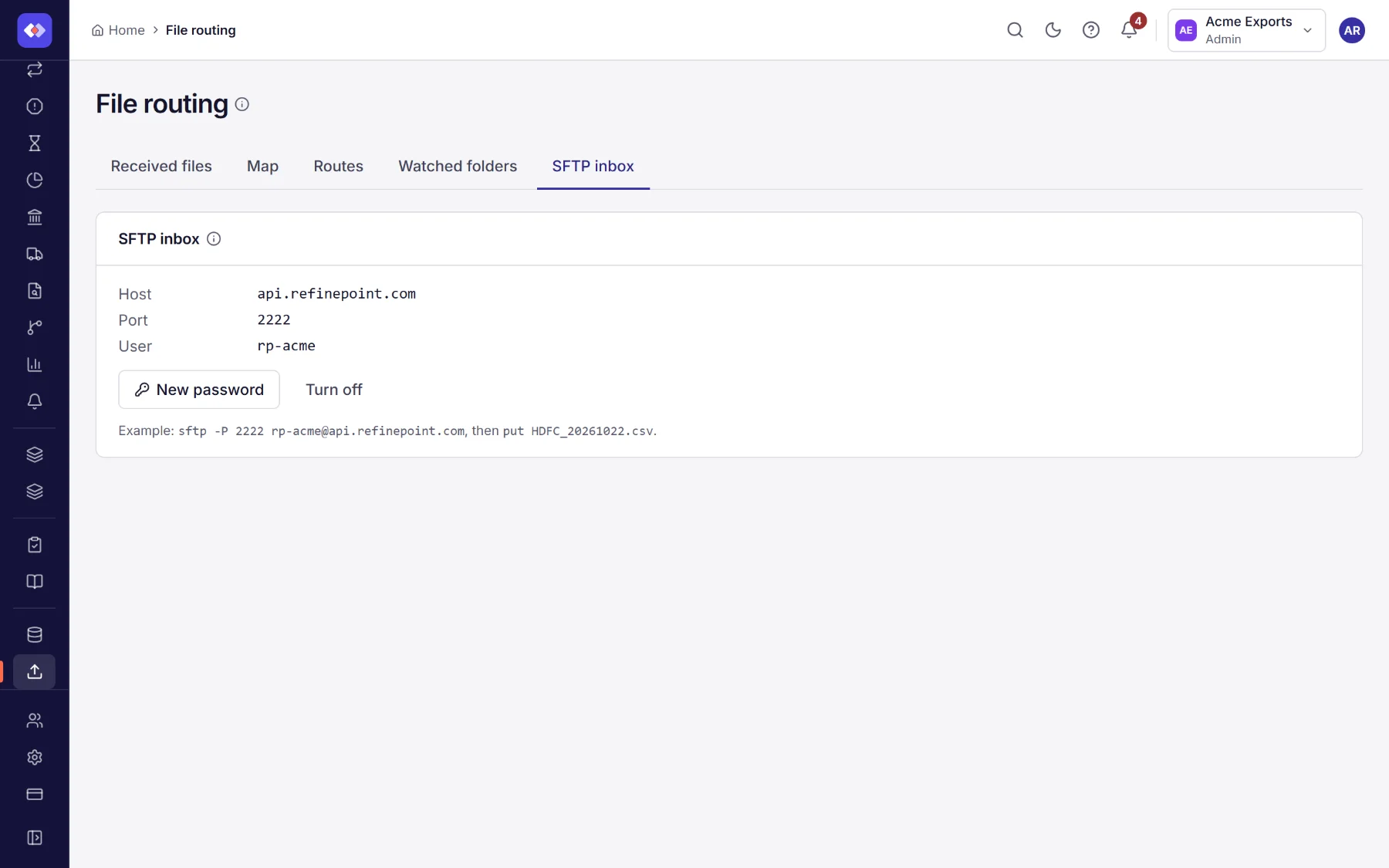
The inbox has its own host, port and user, shown on the tab with an example command. New password creates a password (shown once; copy it into the system that sends files) and replaces the old one. Turn off closes the inbox.
- Choose New password and copy it.
- Give your bank or system the host, port, user and password.
- Add a route for the file names it will send.
- Send a test file and check Received files.
Only workspace admins set up the inbox.
Watched folders
Section titled “Watched folders”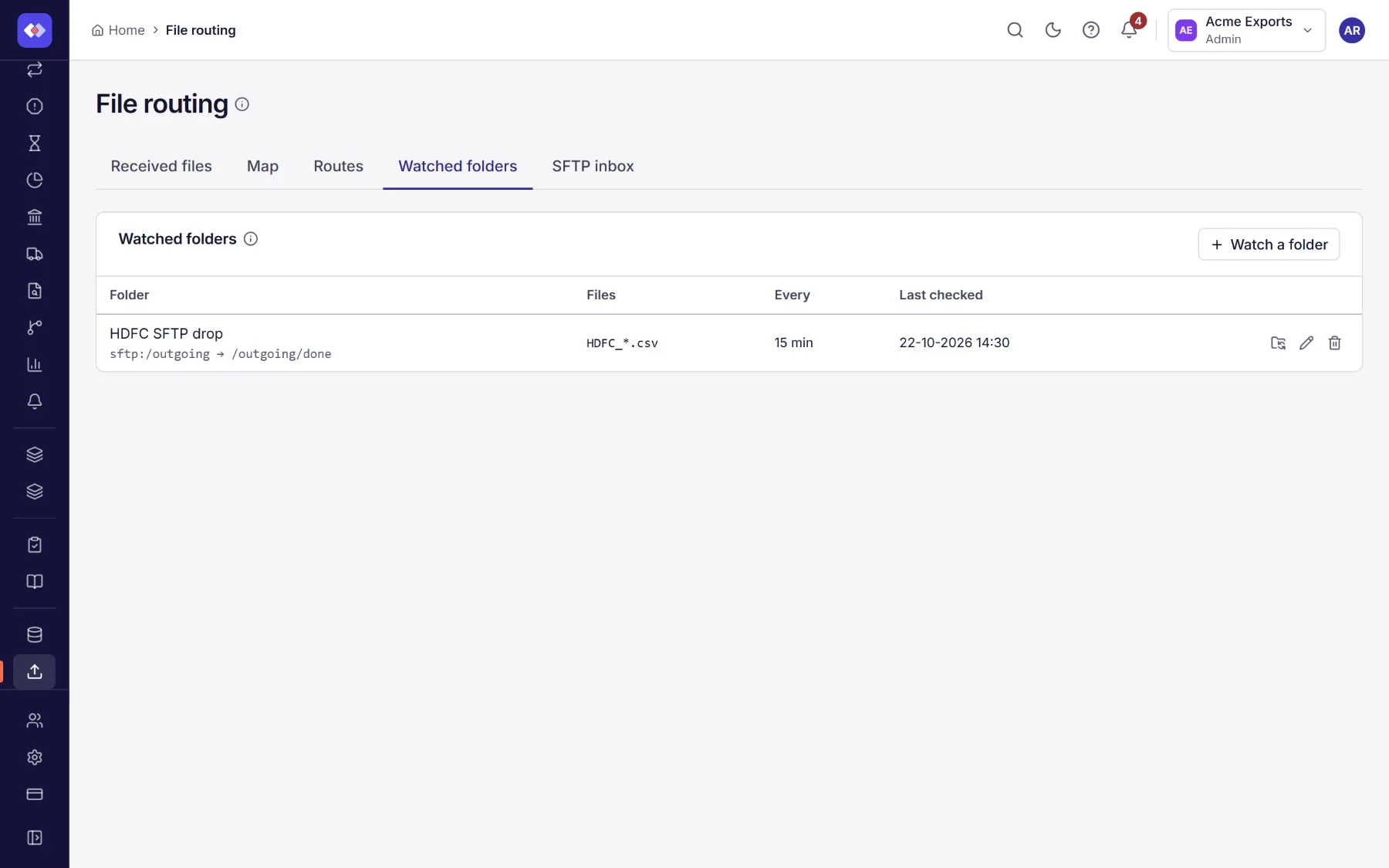
- Save the server’s credentials as a connection first.
- Choose Watch a folder, pick the connection, and give the folder and a file pattern (
*.csv). - Optionally, a folder to move picked-up files to on the same server, so nothing is read twice.
- Set how often to check (in minutes). Check now reads it straight away.
Permissions
Section titled “Permissions”Seeing received files, uploading, downloading, managing routes, the inbox and watched folders are separate permissions (area File routing in the permissions reference).