Creating a reconciliation
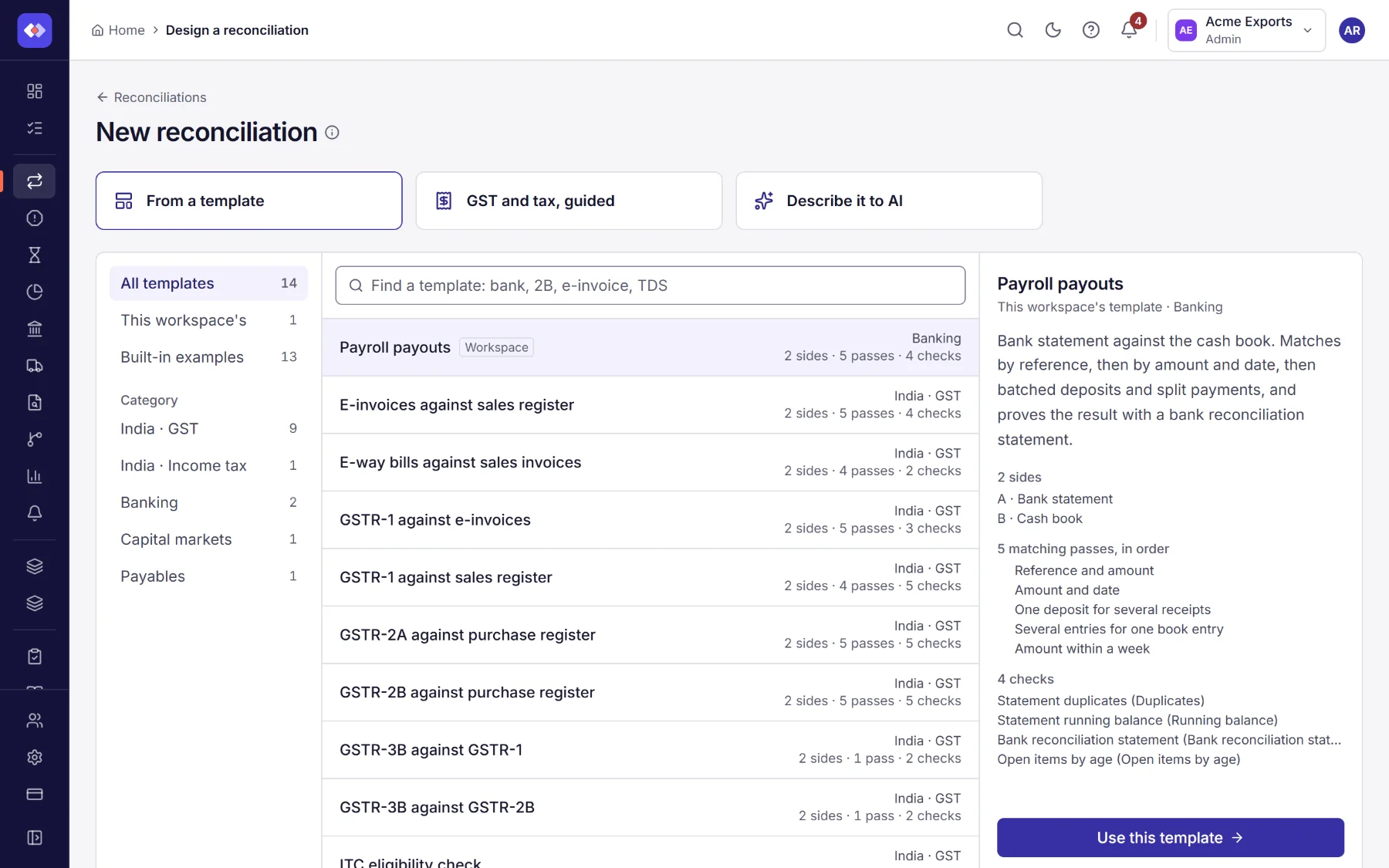
Choose New process on the Reconciliations page. RefinePoint asks where you want to start.
| Start from | Best when |
|---|---|
| From a template | Your reconciliation is a common one: bank, vendor statement, GST, card, payroll, trades… Most people start here. |
| GST and tax, guided | Indian GST, e-invoice, e-way bill or TDS checks: choose the question and add the files. See GST and tax reconciliations. |
| Describe it to AI | You would rather say what you want in a sentence and let the AI draft the set-up. |
| Start from scratch | Two sides with the usual fields (date, reference, description, amount) and one matching pass, for you to shape. |
Whichever you choose, you end up in the designer, where you can check and change everything before saving. Create and run saves it and runs it at once; Create reconciliation saves it to run later with Reconcile now.
Files or data sources
Section titled “Files or data sources”Each side reads one of two things. You choose on the designer’s Sides step.
| A side reads | How it works | Best for |
|---|---|---|
| A file | Upload a file on Sides: its columns set the side up, and nothing is stored as a data source. Every run asks for the side’s file: Reconcile now has a place to choose it. | Statements and exports you download each month or each day, and one-off reconciliations. No data source is needed. |
| A data source | The side reads a data source: files stored in RefinePoint, a shared folder, a web link or a connected system. Runs read it without asking. | Reconciliations that run on a schedule or when files arrive. |
Files are read the usual way: the headings in the first row, the first sheet of a workbook; bank statements and tax files are converted. The sides of one reconciliation can mix both: a bank statement uploaded each run against a ledger read from a connected system.
From a template
Section titled “From a template”A template is a complete, ready-made set-up: sides, fields, matching passes, checks and sometimes reason codes. You only connect your own data and check the column mapping.
-
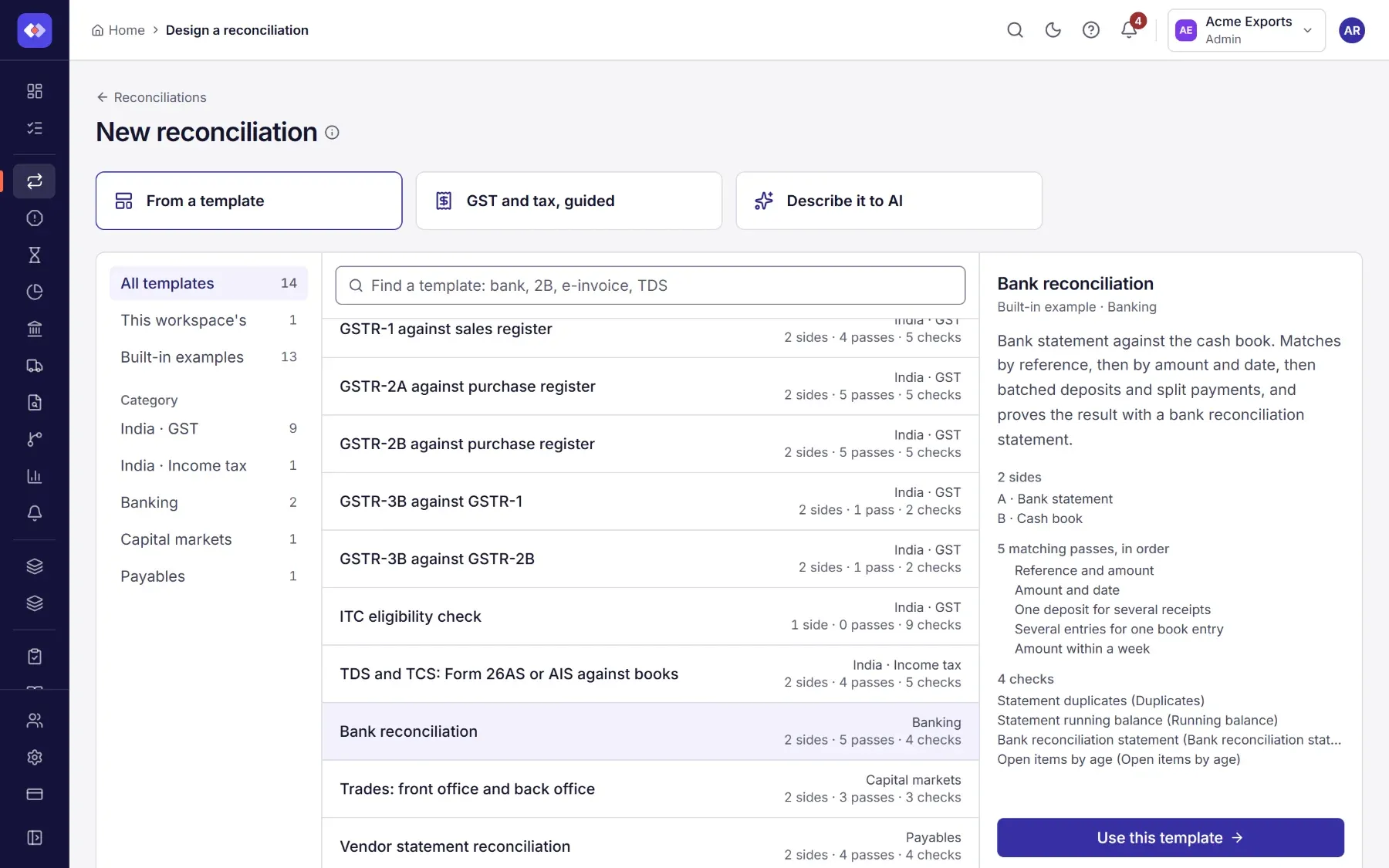
Browse the list on the left, or narrow it with the filters (All templates, This workspace’s, Built-in examples, or a reconciliation type) and Find a template.
-
Select a template. The preview shows what it contains: how many sides and which, the matching passes in order, and the checks.
-
Choose Use this template. The designer opens with everything filled in.
-
On Sides, upload a file for each side, or choose data sources. On Fields, check the column mapping.
-
Create and run to see the results at once, or Create reconciliation to run it later.
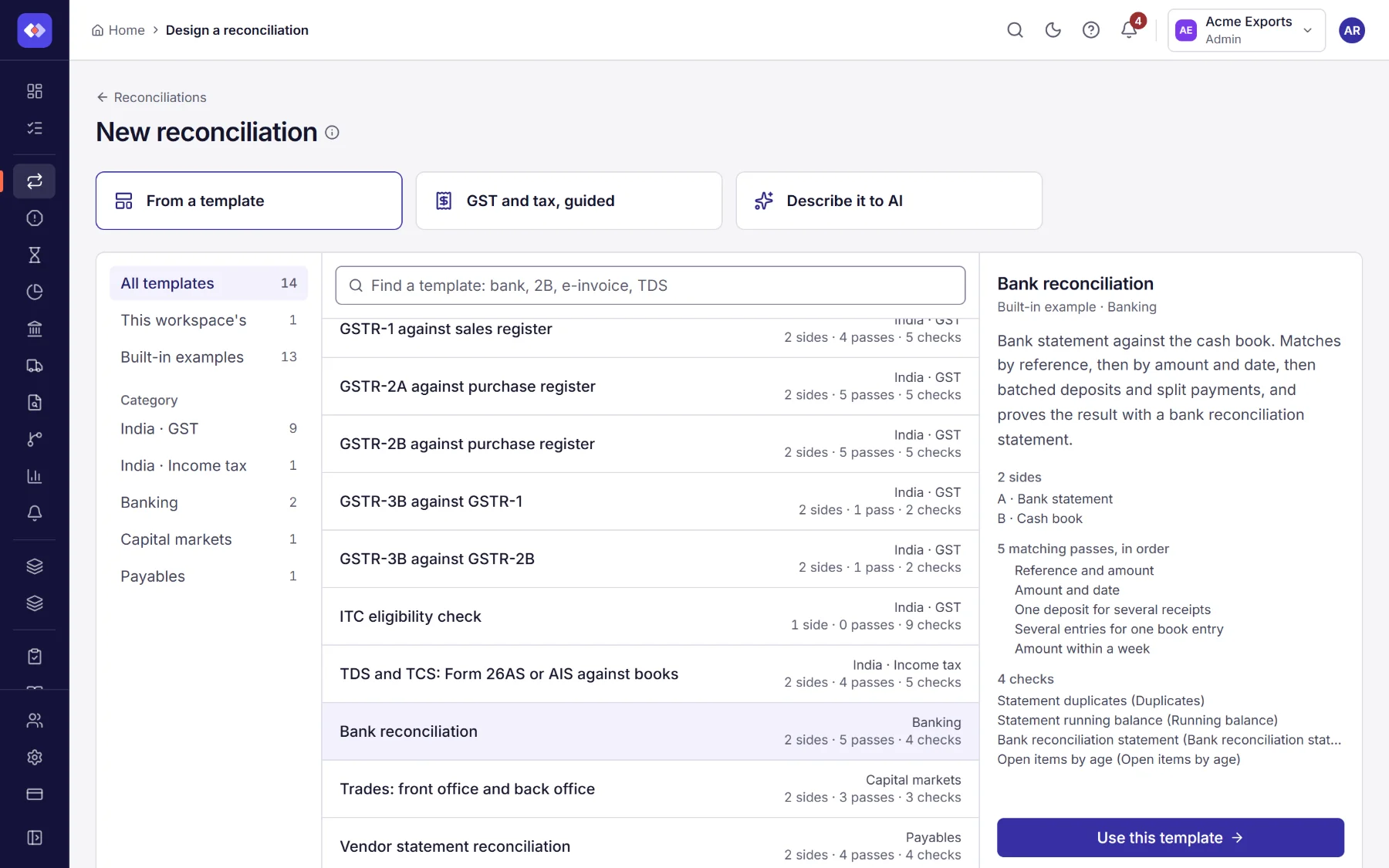
The templates reference describes each built-in template in full. Your workspace can save its own: in the designer, Save as template keeps the current set-up for others to start from, and Settings → Library manages them.
By describing it
Section titled “By describing it”- Choose Describe it to AI.
- Write what it should reconcile and how. Be as specific as you like, for example: HDFC statement against the Tally cash book; match on cheque or UTR number, then on amount within 3 days; flag bank charges.
- Upload the files, or tick the data sources, one per side (up to four). Data sources take the first sides, in the order you tick them, then the files.
- Choose Draft it.
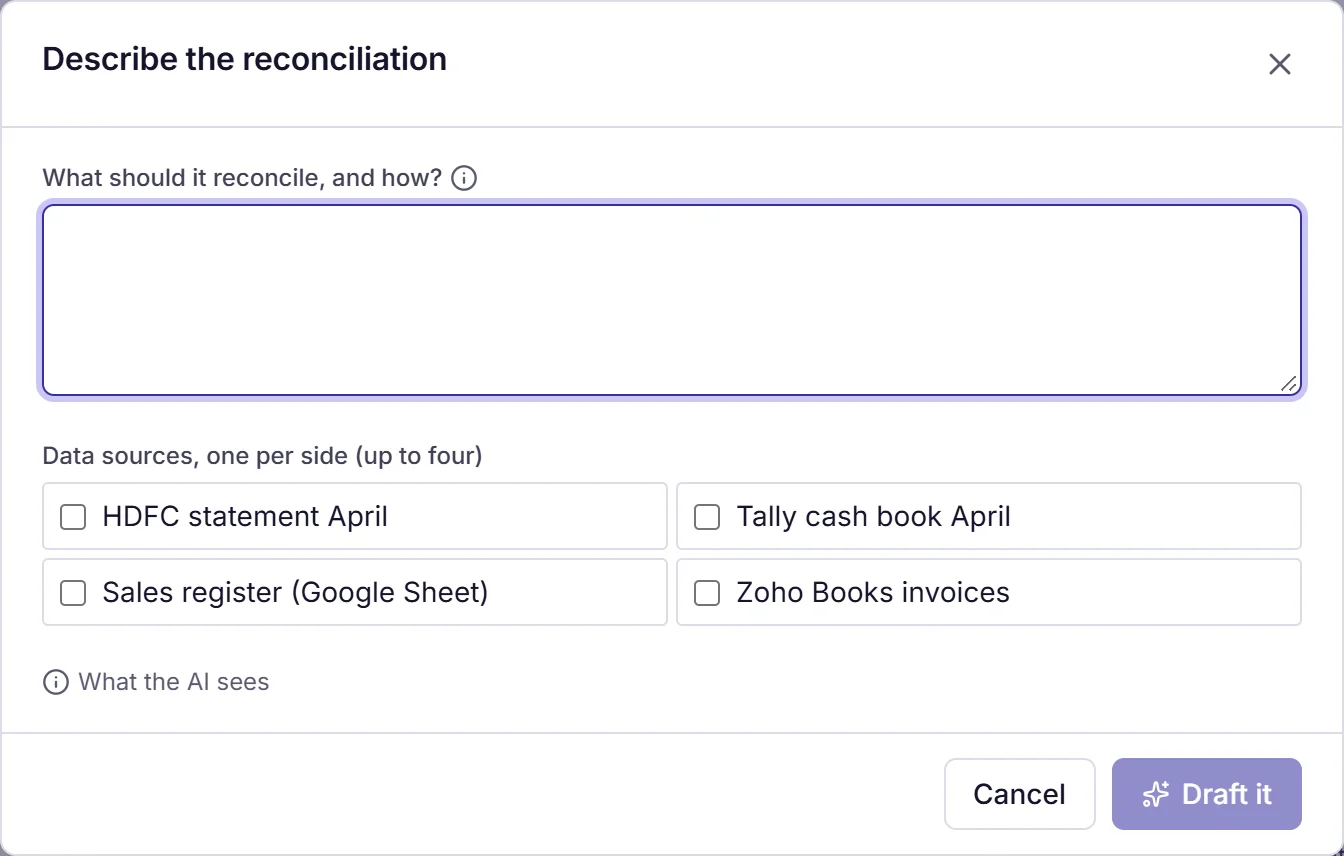
The AI drafts the sides, fields, matching passes and checks, and opens them in the designer for you to review. Column names and a few sample rows of the chosen files and data sources are sent to the AI model; nothing is saved until you save it in the designer. Sides drafted from files read a file for each run, and the files you uploaded are kept in the designer, so Create and run runs them straight away.
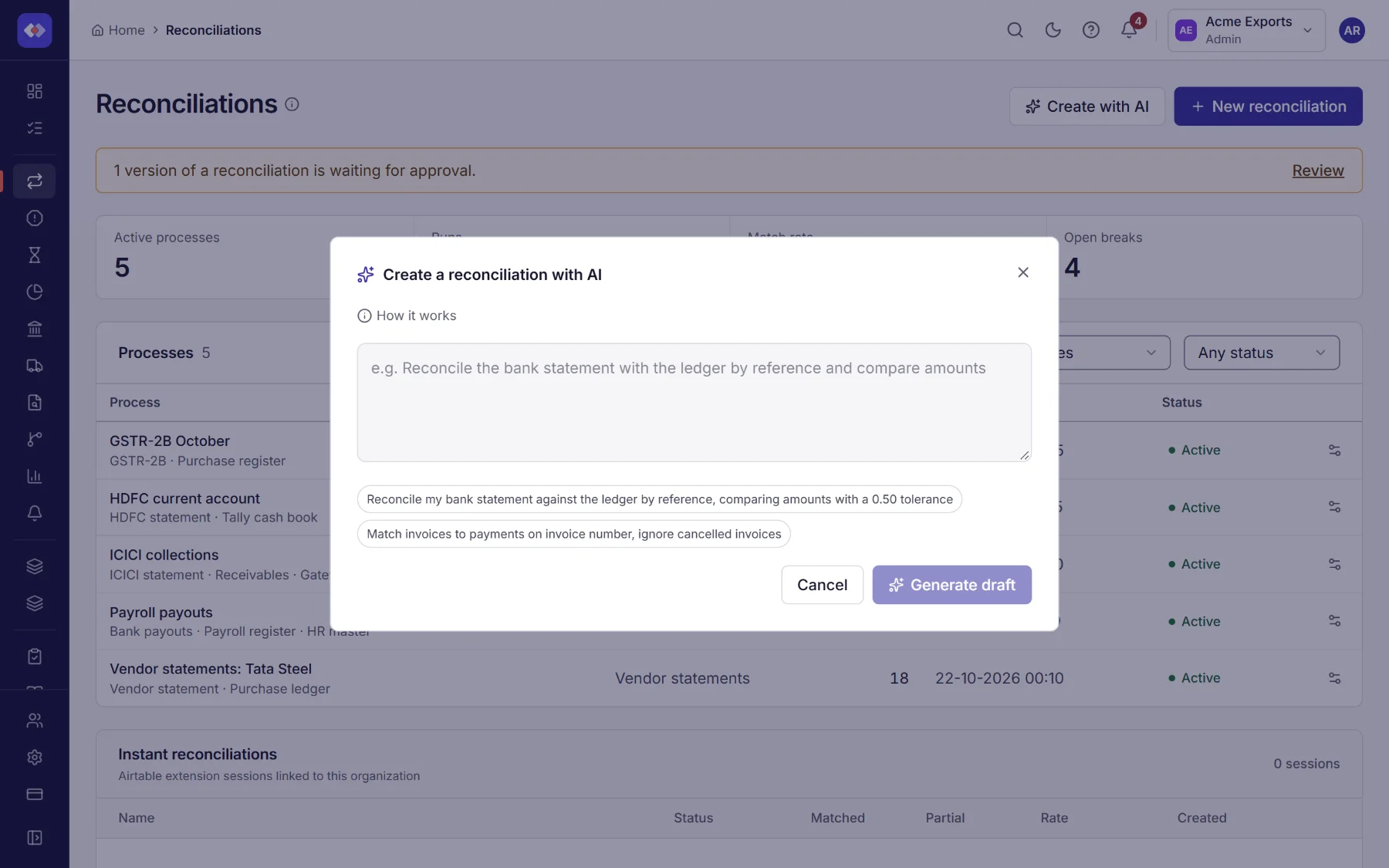
With AI, from the Reconciliations page
Section titled “With AI, from the Reconciliations page”Create with AI on the Reconciliations page opens the designer with Describe already open: upload the files or choose the data sources, then describe the reconciliation in a sentence, such as Reconcile my bank statement against the ledger by reference, comparing amounts with a 0.50 tolerance. The AI proposes the set-up and the designer opens it for you to review, change and save, like any other reconciliation.